I’m a poet, a professor, a mother, a wife, a bit of an activist, a lover of the word at https://kathleenmccoy.wordpress.com. Poetry books include Ringing the Changes (Finishing Line Press, 2019), Green and Burning, Glas Agus a Dho (Word Tech, 2016) and More Water Than Words (chapbook, Finishing Line Press, 2017). Books are available from the publishers or Amazon, or order from your local bookseller.
“When you are in a certain place, great love or kindness happens; it imprints itself on the ether of the place. When we pass there, hungry and needy in spirit, that loving imprint shines on us like an icon.”–John O’Donohue, To Bless the Space Between Us, A Book of Blessings
I keep telling myself that, and it is feeling true, even real. I may have a couple of books behind me, but I’m fairly sure I have a lot more ahead of me. I retired from my full-time professorship after forty-three years of teaching (less six years of writing for a living), thirty of those at one upstate college I have loved very much. So now I’m on a new phase of writing, and while my nervous system is taking the fall off to recover from its natural oversupply of cortisol which makes it challenging to sleep and challenging to rise, what no longer eludes me is the motivation to write. And for that I deeply grateful.
Yet I’m haunted by a long, ongoing project.
There are new projects: a workshop here, a proposed continuing education course for spring, and my own writing, including new poems and poems in need of revision. But what haunts me is my pet project for the next year (or more), a full-length musical theatre play, on which I am honored to collaborate with a top-notch, award-winning composer. My lyrics are getting there, slowly, and I cannot wait to hear the music my collaborator will create, because the music she’s created in the past is first-rate.
The musical theatre play that haunts me began as a brief two-act play that I drafted quickly in the spring of 1982 when I was a fresh college grad waiting for May when I would graduate officially, and for a late-spring/early summer job to commence. I had finished courses a semester early and was delighted to plop on my bed in my parents’ farmhouse every day, listening to the mice scratching in the walls as I penned my script with youthful fervor.
I’m not ready to share broadly the subject, but suffice it to say I was worried about permissions acquisitions when legal had to go through Beirut, which was being bombed in 1982. In fact, Beirut seemed to be under attack every few years when I returned to the project with renewed interest and a growing sense of imposter syndrome. Sure, I’d spent plenty of time on stage during college and graduate school, and I’d taken modern drama and Shakespeare courses, but I’d never studied playwriting, much less songwriting. Then, in the past decade when my dreams started telling me the script wanted to be a musical, I nearly sprang the proverbial gasket. But I was fortunate to be buoyed by my writers’ group, encouraged to stay the course and see the project to completion.
Since I settled on the form and found a composer, things have been proceeding apace. Yes, I need to write many more songs and make changes, and I also need deletions and discoveries to occur during this scripting process. My fingers are crossed for a grant for us as a team to help support this endeavor.
I think of my legacy, of how I need to write to leave something worthwhile behind me (besides students who learned a bit about writing). I think of writers like Christian Bök, the experimental Canadian poet who, a decade ago, published Xenotype, Book 1, the first part of his long-term project to encode a bacterium with his poetry. Together with chemical engineer Lydia Contreras from the University of Texas at Austin, he has now succeeded in encoding his work into Deinococcus radiodurans, a bacterium so hardy it is nicknamed Conan the Bacterium. This DNA-encoded bacterium has now been engineered to generate an RNA response poem written by the bacterium. Talk about a legacy.
By contrast, I’ll be happy if my poems reach a few more readers in the coming years, and my stage piece makes it to the stage. And, of course, in the process, I expect to grow and keep growing. I’d really like to surprise myself.
Now, I’m in it for the long haul. After forty-three years of cogitating on a piece, I cannot let it go until it’s dressed and ready to leave on its own. Theatre does that; it engenders a response. Poetry does too.
For now, I’m inspired by poets like Christian Bök and also by Barbara Ungar, who writes compellingly about the plight of the earth, our responsibility for its longevity, and our own mortality. The following poem excerpted from Save Our Ship celebrates aging as its own reward. Under the title of each poem in her collection is Morse Code. Save Our Ship features blurbs by Mark Jarman and Bernadette Mayer, who wrote, “If poetry sends signals out into the universe, and aliens could intercept and interpret these poems as code, they might answer, Read poetry Save yourselves Buy this book.”
I couldn’t agree more. And as a survivor of three joint replacements, I revel in the genuineness of Ungar’s positivity in “How the Light Gets In.” Save Our Ship won the 2018 Richard Snyder Memorial Publication Prize.
How the Light Gets In .__.. .__.. .__.. .__.. .__..
Don’t call it your bad hip— recall the Japanese art of kintsugi and be the cracked vessel patched with gold.
Don’t wince when it squeaks but thank the bright steel cupping your pelvis and capping your thigh.
Don’t be shamed by the scar— you’ve wrestled till day break with man and god, and managed to limp away blessed.
Poems and Photos by Kathleen McCoy, Painting by John Hampshire, SUNY Adirondack October 23, 2019
How might poets and painters explore and reinterpret the complexities of identity/-ies? These days, not only are borders in flux, but the often-fraught term “identity” is nearly always complicated by multiplicity and intersectionality. We define ourselves partly by inheritance and partly by choice, often while standing at those often foggy bog-borders of ethnicity, geography, gender, religion, or any of a number of other foci of identification. We need the arts to help us navigate our way toward and across the borders of our lives in hopes of approaching self-understanding and, eventually, mutual understanding. Audre Lorde said it best at Harvard in 1982: “I learned that if I didn’t define myself for myself, I would be crunched into other people’s fantasies for me and eaten alive.” At the very least, the arts help us ask the questions and meet the people we need to encounter to discover where and to what extent we can really see at all.
These boglands of identity are deep and sometimes treacherous. I would never want to idolize, demonize, patronize, tokenize, or any other -ize anyone. At the same time, we can’t pretend our differences wholly define us any more than we can pretend they don’t exist. Ultimately, I want to see and to bear witness to how I see, just as I want to hear and read and watch how others see. In crafting art, in interpreting and reinterpreting selves and worlds, we’re all adding brushstrokes to a much larger mural than any one of us can hold.
Yesterday artist John Hampshire painted live on stage while I read poems-in-process on the theme of identity/-ies (here is the video link). He started with one portrait and plans in coming days or weeks to add more until he has created a canvas montage on identities. During our presentation I explored my roots in America and Ireland, sharing some of my travels and interests in indigenous Americans, the ancient Irish, and the bog bodies of Ireland that Eamonn “Ned” Kelly has studied and interpreted for the Kingship and Sacrifice exhibit at the National Museum of Ireland in Dublin. Seamus Heaney portraits kept appearing over my shoulder in Ireland, and Medbh McGuckian, Leontia Flynn, and Scott Cairns were my travel-muses.
Whoever you have been, whoever you are, whoever you’re becoming, I’d like to offer a friendly challenge to write an identity poem of your own, or paint a portrait. Or both. As Joy Harjo writes, “We pray that it will be done / In beauty. / In beauty.”
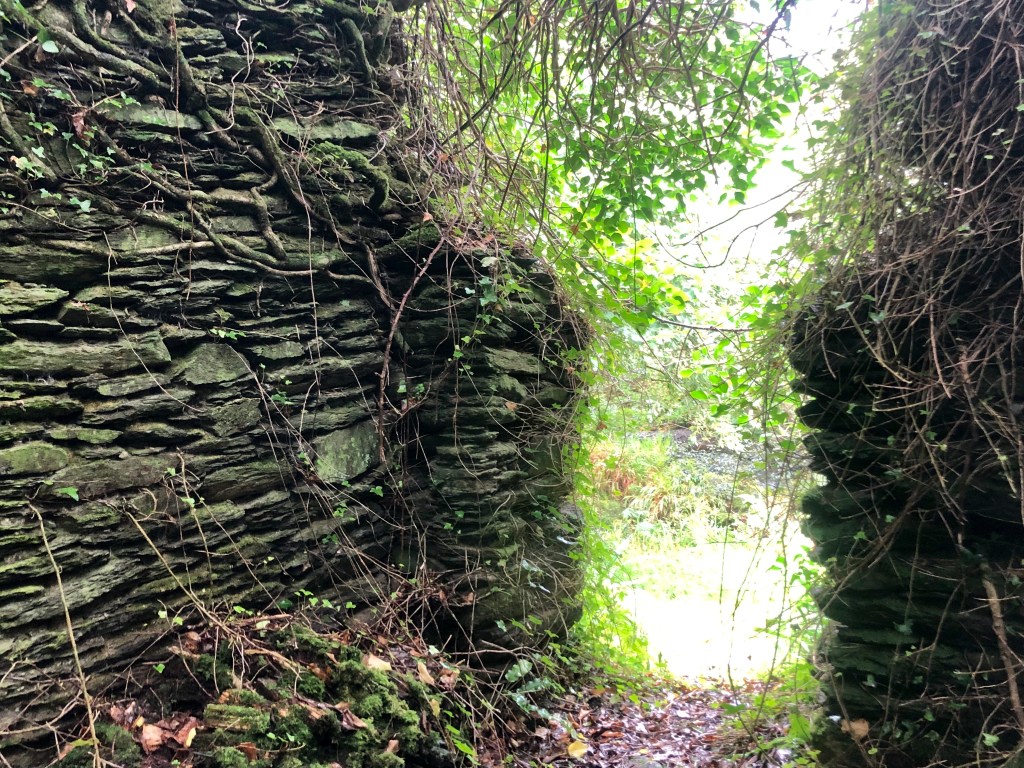
The Old Mill Ruin at Anam Cara Writers’ and Artists’ Retreat, Eyeries, County Cork
Last year I had a student who struggled with conflicting feelings about belonging and otherness in college. I could write that sentence about any semester, any class I’ve taught, particularly any writing class. Since each of us humans comprises a nexus of cultural, genetic, and chosen identities, I’ve shared students’ ambivalence about identity, despite the pallor of my complexion. As a result, I’ve been exploring how poetry in particular and the arts in general help us to confront our self-conceptions, choose our identity/-ies, and empower ourselves as writers and citizens. Theories abound; studies are few but extant. But the arts vivify the questions. The arts validate those who question and help close the chasms between us.
In the first eight months of 2019 I used sabbatical time to ponder issues of identity and poetry as I wrote, read, and presented at conferences in Ireland, Northern Ireland, my native southern Ohio, and Santa Fe, and worked with local high school students who were new to poetry.
Questions about relativity in identity and language, in the sciences and poetry, in art and teaching swirl. My mind now braids themes of identity in teaching, in poetry, in art, and in ethnicity.
On October 23rd at 12:40, I will be joined by the legendary artist John Hampshire in the Visual Arts Gallery of Dearlove Hall at SUNY Adirondack. I will discuss my sabbatical and read poems while John paints in-the-moment. If you come, you may find a bit of yourself in the words or on the canvas.
Welcome, Haley, to my website! Thanks for reaching out to me. I’m adding the poetry website you recommended, Playground Equipment.com, so other young people can enjoy it like you do. Keep reading, keep writing, and keep connecting!
I’ll be selling and signing my poetry books at the Adirondack Center for Writing, https://adirondackcenterforwriting.org/, 15 Broadway, Saranac Lake, NY on Thursday, August 17, 2023, 5:00-7:00 p.m. If you’re around for the Third Thursday Art Walk, come say hi and put your name in for a free book. 😊
On the first Wednesday of every month, Caffe Lena hosts Poetry Night, inviting anyone who will come to listen to new and published poetry by some of the many local poets. Caffe Lena stands as a local legend, a venerable coffeehouse in Saratoga Springs known as America’s longest running folk club that was made famous in the ’60s for hosting the likes of Bob Dylan, Pete Seeger, Don McLean, and more recently, Adirondack legends like Jamcrackers and others. In the poetry scene, host Carol Graser has brought many fine poets to the stage, including Stuart Bartow, Elaine Handley, Marilyn McCabe, Bernadette Meyer, Jay Rogoff, Mary Sanders Shartle, Barbara Ungar, and Nancy White.
In the pandemic, they’ve moved temporarily to Zoom and YouTube. The benefit, of course, is that YouTube recordings will remain available until the internet burns down. So it’s my pleasure to share the Poetry Night video featuring the amazing poets Lucyna Prostko and David Graham, followed by yours truly. As we read, common subjects emerged–birds, characters, elegies. The video was filmed on February 3, 2021.
Host Carol Graser with Lucyna Prostko, David Graham, and Kathleen McCoy
Whether with dread or welcome, we find ourselves at Valentine’s Day yet again. It’s a challenging day to teach creative writing to undergraduates. In teaching my students to notice what works best in their own poems, they’ve started already (three weeks in) to recognize the lasting appeal of love poems that express complication without surrendering to despair.
This modern love poem doesn’t work well for white chocolate lovers. Too high a tolerance for sweetness. Permit me a moment of synesthesia when I say that if your tastes turn to a bit of bitterness, darkness, or chili with the chocolate, the sound of the taste resonates far longer and more pleasantly.
It seems to me that many poets have done this, though, arguably, none better than the late Seamus Heaney. Featured today on Poetry Daily is his poem “Scaffolding.” A friend and colleague commented that the “wall” in this poem resonates differently in the Trump era; however, despite the obvious temporal and situational contrasts, I challenged that idea. Consider how Heaney endured the Troubles in Belfast with its sectarian divides rendered in concrete “peace walls” before he defected to the Republic and eventually the States. The image of a wall is fraught with tension, yet in “Scaffolding” he appreciates the solidity, the creation, the relationship between the poem’s couple who set up the scaffolding in order to build the wall. Heaney’s metaphor celebrates letting the scaffolding go to show that a relationship builds something new, something that establishes boundaries and claims territory at the same time that it represents a mutual, hard-won peace. A peace wall carves out a space where people with their own differences can meet. Only then can love be realized. Enjoy.
Join me for a holiday poetry reading featuring some great American holiday poems plus several by yours truly on Thursday, December 10, 2020 at 7:00 p.m. Eastern Time. Check out my books on the “Books” page above. This free reading is sponsored by my friends at the Adirondack Branch of the American Association of University Women. #aauwadirondack #aauw #poetry For the link, please email adiraauw@nycap.rr.com.
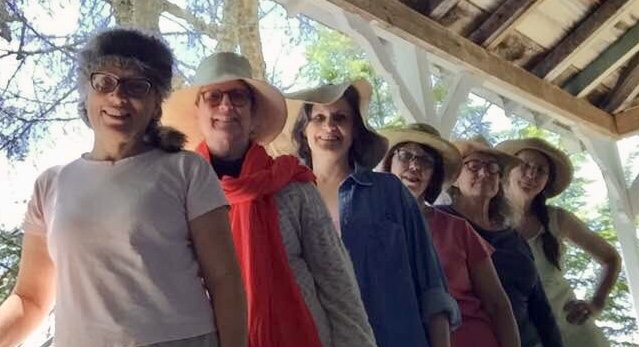
Women of Mass Dissemination: Marilyn McCabe, Mary Sanders Shartle, Kathleen McCoy, Elaine Handley, Nancy White, and Lale Davidson
What could be more fun than a glass of beer or wine and a six-writer, one-hour reading of original poetry, fiction, nonfiction, and collaborations? If you’re at a loss, note that the six award-winning writers Women of Mass Dissemination will read from their collaborative and individual poetry, fiction, and nonfiction at The Parting Glass on Saturday, April 27, 4:00 p.m., at 40-42 Lake Avenue in Saratoga Springs.
Nancy White is president of Word Works Books in Washington D.C. and author of Sun, Moon, Salt (Washington Prize winner), Detour, and Ask Again Later. Marilyn McCabe is the Washington Prize-winning author of Perpetual Motion and Glass Factory. Mary Sanders Shartle penned the multiple-award-winning novel The Truth and Legend of Lily Martindale. Elaine Handley is the author of Letters to My Migraine and Securing the Perimeter and collaborated with Mary Sanders Shartle and Marilyn McCabe on chapbooks Notes from the Fire Tower, Glacial Erratica, Winterberry Pine, and the full-length book Tear of the Clouds. Lale Davidson is the author of the award-winning chapbook Strange Appetites and columnist for The Times Union. Kathleen McCoy is the author of chapbooks Night-blooming Cereus and other poems and More Water Than Words and full-length books Green and Burning (finalist in Book Excellence Awards) and Ringing the Changes, forthcoming in June.
We’ve been supporting each other as a writing group for over a dozen years. Come share the cheer with a “Cheers!”







 The Real McCoy