I’m a poet, a professor, a mother, a wife, a bit of an activist, a lover of the word at https://kathleenmccoy.wordpress.com. Poetry books include Ringing the Changes (Finishing Line Press, 2019), Green and Burning, Glas Agus a Dho (Word Tech, 2016) and More Water Than Words (chapbook, Finishing Line Press, 2017). Books are available from the publishers or Amazon, or order from your local bookseller.
elude me this winter, this long winter. The snow remains, melting flake by flake. Even so, we know the day will come when ground is sufficiently dry to respond, to whip grains of ground into a mini-vortex and send its origami cranes skyward again. Writers can’t wait. We witness it all, we soak in snow, we turn blue, we shake ourselves dry and warm ourselves up and go out again and again until at last the rustling begins, the winds lift our latches, open our cocoons.
Eudora Welty tells us “True daring starts from within” where, whatever the weather, we’re not just waiting. We’re raw, we’re real, we’re ready.
A poem by Dante Di Stefano, “A Drone Pilot Discusses the Story of Abraham and Isaac” (http://www.amethystarsenic.com/issues/4-1/dante-di-stefano.php) compares Abraham’s faith on that day he offered up his son to the kind of everyday faith with which we live our mundane lives, faith that, for example, if we wait in line at a store, we will be served, if we offer up our credit card, the purchase will be successful. “You don’t question the altar or the knife,” he writes. “You don’t ever doubt that the Walmart/will carry the Tide marker you need…” This is kind of stunning, this deep empathy with Abraham’s point of view, speculative though it may be, ironic, rueful. I thought of this poem when I heard a lecture by Alain de Botton about our culturally-based ideas of success and failure (http://www.ted.com/talks/alain_de_botton_a_kinder_gentler_philosophy_of_success). He claims our contemporary understanding of them can lead us to discount the…
Poets, like humanoids of all stripes, play a balancing game on a daily basis. Grade papers. Run to meetings. Teach classes. Run kids to events and activities. Check in with the spouse. Dust once in a blue moon. Throw leftovers in the microwave. Eat. Run some more. Rinse. Repeat.
It’s what Ekhart Tolle, in A New Earth: Awakening to Your Life’s Purpose, calls “finding a balance between human and Being” (104). The human part of us is the ego, which is wedded to the roles we play–poet, teacher, wife, mom, etc., etc.–while the Being at our core is timeless, disembodied, the Spirit that transcends all our earthly errand-running, role-shifting, ego-propping, power-grubbing, material-minding chaos.
Today, it’s meeting with the WMDs (Women of Mass Dissemination) to tweak, update, and generally improve our web sites. Tonight it’s marking draft poems for students who are (generally) more confident about their fiction.
But soon–not now, but SOON–it will be just the page and me. Setting the “human aside.” Connecting with poetry. Just . . . Being.
Daughter, do not give your stories to the wind . . . . — “For My Daughter” by Kathleen McCoy The Willows Bistro in Warrensburg, New York is hosting a book signing/reading event this Saturday, December 7th. I will be selling copies of my chapbook, Night-blooming Cereus and other poems, for $5.00. (Makes a decent stocking stuffer.) I’ll be there from 10:00 – 11:30 a.m.
There may never be a time when it is more important to bring the Big Ideas of Peace and Sustainability home. And nothing brings Big Ideas home to roost like poetry.
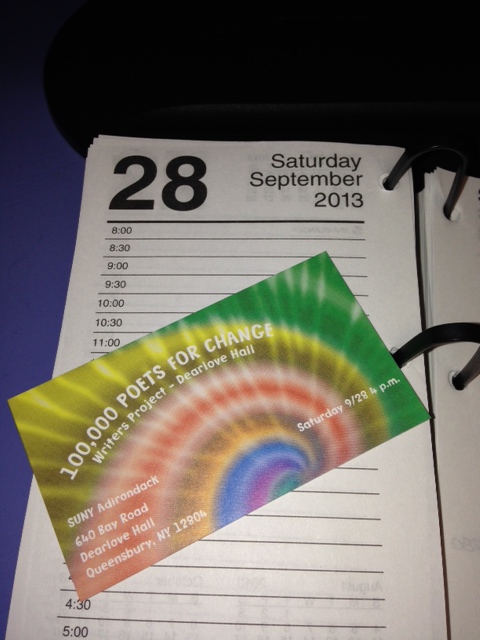
It’s been my joy to assemble local poets, artists, and thinkers with a global initiative: the SUNY Adirondack Writers Project is sponsoring 100 Thousand Poets for Change, a poetry reading and informative gathering for peace and sustainability. And heck, I get to say that “Philip Levine likes us on Facebook, and so does Caffe Lena Poetry!”
We have a line-up of award-winning and student poets, artist John Hampshire‘s work, and mini-talks by professors Tim Scherbatskoy on sustainability and Rebecca Pelchar on art and peace.
How do you feel about “poetry of witness”? I’m referring to a still-debated term used by Carolyn Forche and other poets that respond in their poems to the injustices, oppression, and violence suffered by others.
At the recent AWP conference in Boston, I heard wonderful poets–from the Old Guard and the Newer alike–including Sharon Olds, Olga Broumas, Kathleen Graber, and Kimiko Hahn–praise Adrienne Rich and Muriel Rukeyser. Carolyn Forche is a long favorite of mine as well.
It’s one of many paths poetry can take, and this one can be fraught. My poetry mentors of the ’80s were mostly men who were, while brilliant artists, indoctrinated in the view that any brand of “political poetry” was, categorically, bad. Today I’m sure their views are more nuanced. At least, I like to think so. I don’t think they would have argued that Wilfred Owen’s “Dulce et Decorum Est” is a bad poem, nor Randall Jarrell’s “The Death of the Ball-Turret Gunner,” but when it came to feminism, domestic violence, abject poverty, and a host of other social issues, they turned away, huddled over poems that remained intensely personal or philosophical. I’ve noticed, over the years, that much of this work is written by women or people of color against whom they would never overtly discriminate today.
What makes “political poetry” good or bad? When does some measure of social activism cross the invisible (perhaps undulating) demarcation between compassion and schlock or opportunism or appropriation of others’ experience?
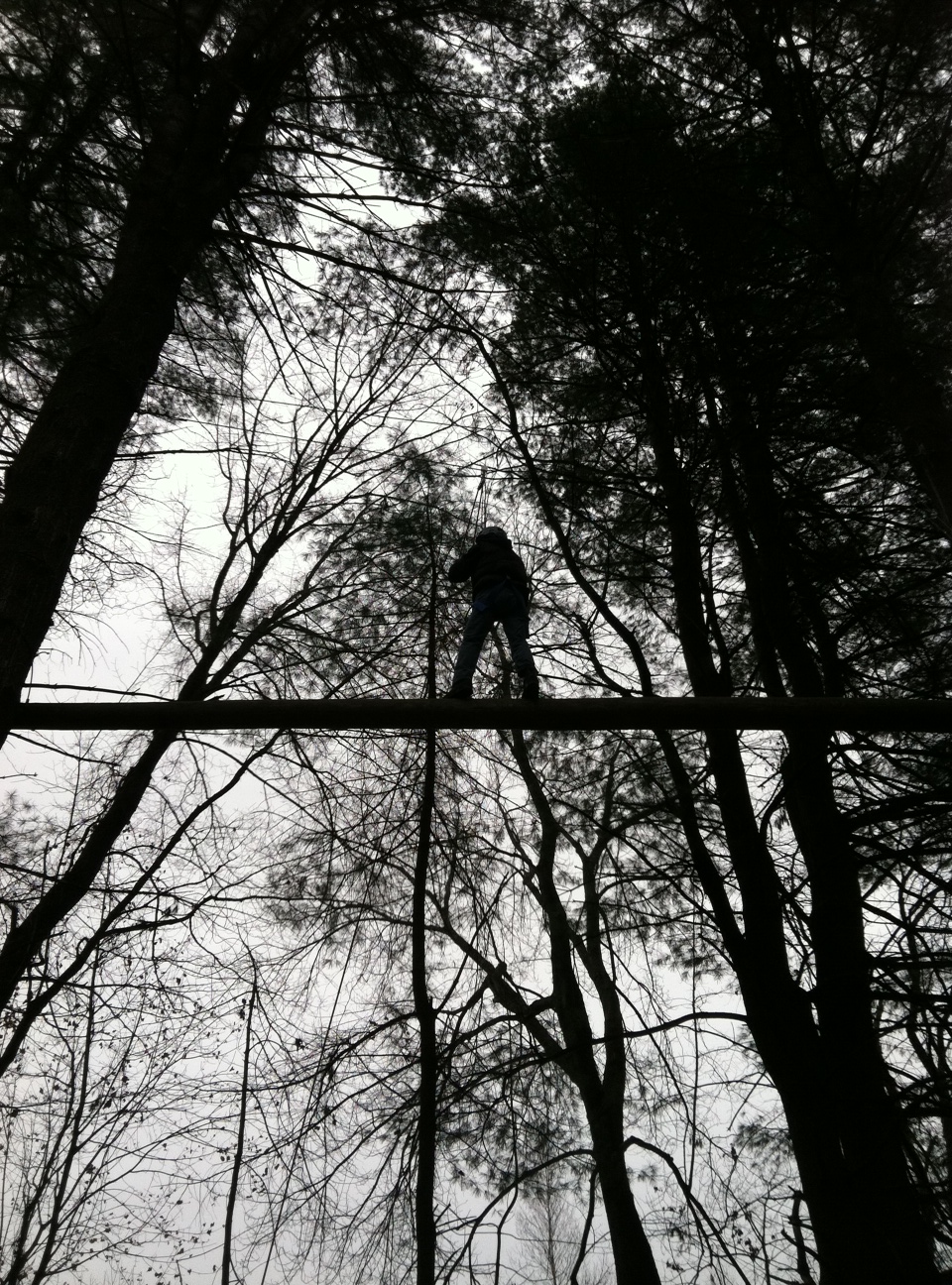
This year, I’m challenging myself–and any of you who care to join–to claim your own catwalk to move across steadily and with as much grace as we can muster. I’m not talking about a Kate Moss catwalk, but the kind that’s tethered near the tops of trees, a single cable you inch across for the heady experience, and just to convince yourself you can do it. Mine has something to do with picking up and moving on without one of my biggest cheerleaders, searching for contact with the wire, checking my fear at the tree and pressing on to the next one. (And yes, that’s me in the photo last year, nearly hyperventilating with a fear of heights but moving across as I’d urged my students to do. We all made it, unscathed.) The breeze will blow; my balance will not be constant; the air will grow cold. But walking the line requires trusting I can find some words, some truth. I’m harnessed in, after all, so all I love will break my fall.
In her poem, “Apples,” Grace Schulman writes, “beauty strikes just once,/ hard, never in comfort. For that bitter fruit,/ tasting of earth and song, I’d risk exile.” The act of inching across the catwalk is a deliberate pursuit of beauty, but the risk is real, and it can feel like exile. Waiting months for the response of an esteemed publication. Then getting it. Over and over. There are compliments as well as critiques. There is hope. But the rope is high and the trek is long.
This month, I’m revising (for the twenty-something time) several poems in an evolving book-length manuscript while trying to work up a new class on portfolio development for creative writers and kick out a couple of new poem drafts. Then it’ll be a recommitment to sending out small batches of poems. Step by pensive step, I inch across. I think of my lifelong cheerleader, my confidante, my first reader, whose death still does not quite feel real. She wanted to be a writer, but wrote very little. She did publish one article and write a couple of stories and a song. She really wanted me to succeed. I have to walk the walk for myself . . . but I know it’s for her, too. At this rate I may not break any land speed records, but then, I’m not touching the ground.
So, what is your catwalk? What’s your plan to get across?
Editor’s Note: Though the “Poet Laureate” honor has never been my cup of tea (given the politics present in such selections), I do occasionally visit whatever fashionable Laureates have been honored on the American scene just to see if they have done anything of value for the poetry cause while holding office.
I’m pleased to remind/report that though Billy Collins (far from Laureate material in my humble estimation), sure did one fine thing in his brief “hour upon the stage”: edit the anthology, POETRY 180, A Turning Back to Poetry, an anthology of contemporary poetry that speaks so plainly, so perfectly to one and all.
He also wrote a magnificent intro to this book, wherein, in part, he describes the discomfort many readers experience dealing with a poem. Having experienced the war zone of trying to teach poetry on the…

 in memory of Eva Leah Robinson McCoy







 The Real McCoy